
Project Case
Pelikaanstraat
-

- 2025 - 2027
- Permit
- IQ housing, Novum Estate
-
Pelikaanstraat
-
Student housing
-
2.492sq m above-ground GFA 408sq m underground GFA 62 bicycle parking spaces
-
Pelikaanstraat 38, 9000 Gent
concept
This project involves the renovation and conversion of a former provincial archive into student housing in Ghent.

Project Description
The building that forms the basis of this design is the former provincial archive. With its industrial character, the structure likely dates back to the Interbellum period.
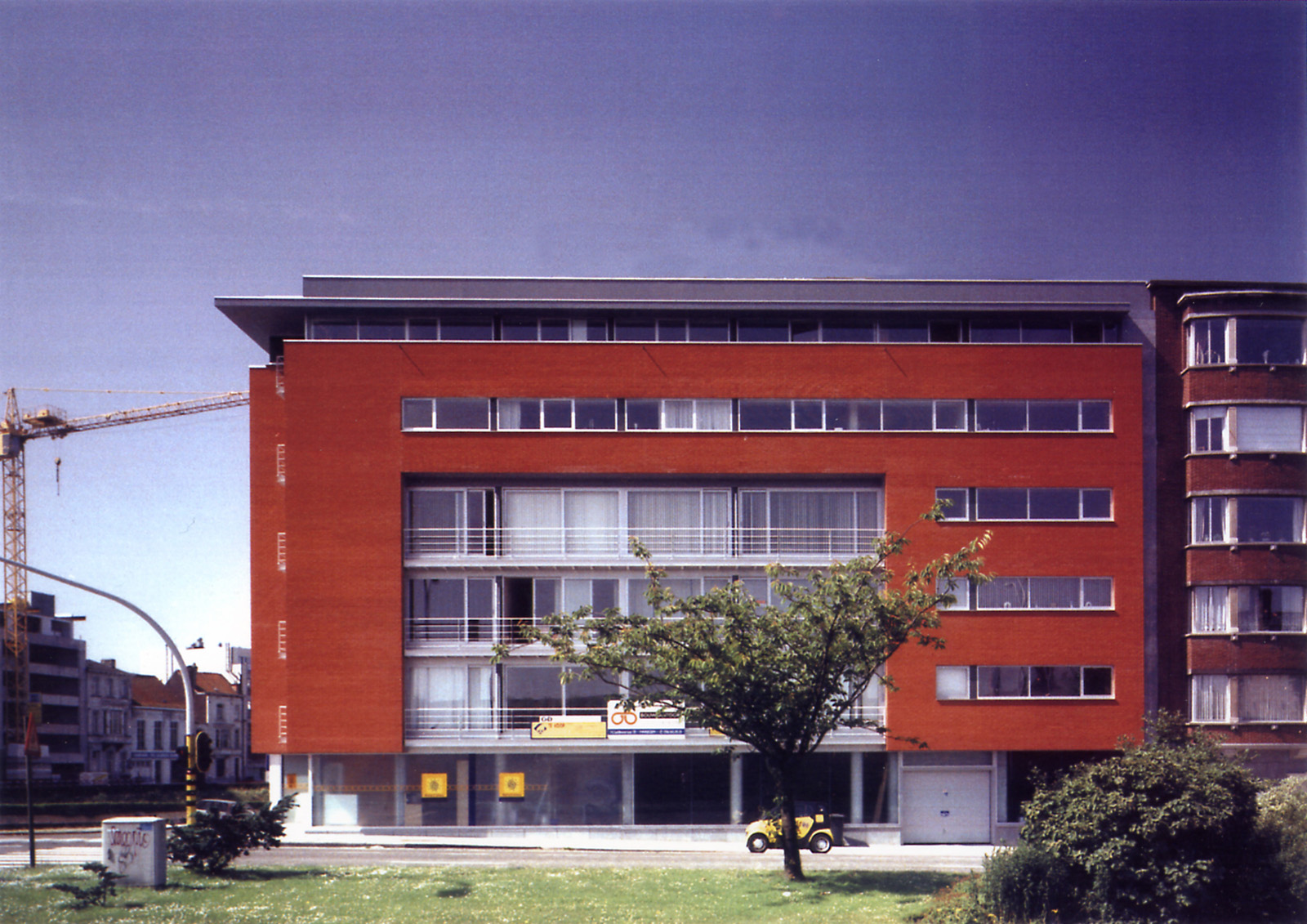
The red-brick façades are defined by strong verticality through projecting piers, balanced with horizontal accents such as cemented lintels and concrete window sills. Near the roofline, corbelled brickwork provides a refined finish, while the white window frames reinforce the sleek, vertical expression of the building.
The main entrance is located in the Abeelstraat. This generous entryway leads to a central axis running through the building, punctuated by multiple steel doors featuring vibrant stained-glass panels. A secondary entrance in the Pelikaanstraat is marked by a stately steel door opening onto a staircase clad in elegant marble.
For the conversion into student housing, a conscious decision was made to preserve these valuable elements. The entire front façade remains intact, while the windows are replaced to meet contemporary standards. The new layout replaces glazed fanlights with glazed lower sections, removing the need for parapets while retaining the vertical character. The façade is insulated on the inside, ensuring its authentic appearance is fully preserved while meeting today’s comfort and energy requirements. Both existing entrances remain: the main entrance in the Abeelstraat becomes the access point for pedestrians and cyclists, with direct connection to the underground bicycle storage.
The building includes a semi-basement with windows, exclusively accommodating supporting functions such as bicycle storage and student lockers. This semi-basement results in part of the ground floor being organized as a split level, adding a distinctive dynamic to the building.
At the heart of the building lies a large patio. Until 2001, this was likely an outdoor space but a previous renovation enclosed it, transforming it into an indoor area. In the new design, this intervention is reversed: the central space is reopened, bringing daylight into the block and creating a bright, green courtyard. Student rooms are arranged around this outdoor patio, benefiting from natural light and views. The courtyard itself will feature a green roof, combining functional use with a pleasant and inviting living environment.
The many existing steel beams, once necessary for the archive’s function, will be left exposed alongside the original concrete girders. Wherever possible, existing materials such as bare brickwork and raw concrete ceilings are retained—a subtle nod to the building’s former purpose.
The project provides space for 55 student rooms and 1 student apartment. Each floor features a shared kitchen and living area along the street façade. Positioned centrally, these communal spaces minimize disturbance to neighboring houses while maintaining a visual relationship with the street. At night, this results in a lively façade that enriches the streetscape. Communal sanitary facilities are located at the rear, away from the entrance halls, to ensure privacy for residents.
A conscious choice was made for a mix of different room types, catering to diverse student housing needs. Students can choose between fully equipped studios or rooms that make use of shared sanitary facilities, kitchens, or both.
The design emphasizes renewable energy and ecological measures. The building envelope is fully insulated and heated with heat pumps. A mechanical ventilation system with heat recovery (system D) will be installed, along with high-performance windows, rainwater reuse, and a green roof. Acoustic comfort is a key priority, ensuring every student enjoys optimal rest. Accessibility standards are fully met, with wheelchair-accessible sanitary facilities and one studio adapted for residents with reduced mobility.
Through all these interventions, the aim is to create a comfortable, vibrant, and welcoming living environment—one that not only provides students with a place to live, but also a place to connect and share life together.


More Projects

Commercial
The Banks
Healthcare
Kruishove
Residential
Pelikaanstraat

Meergezinswoning
Henleykaai 4

Meergezinswoning
Markt Lokeren

Residential
LOOP 7
Eengezinswoning
Jack & Elie

Meergezinswoning
Smissepark
Commercial
Greenfield
Commercial
Project Gouwy
Eengezinswoning
Residentie De Loy
Meergezinswoning
Park Léon

Meergezinswoning
Residentie James

Commercial
Residentie Espark
Commercial
Hof van Achten

Commercial
Jardin Callier

Commercial
Sint-Pieterspoort
Meergezinswoning
Market square Lokeren
Eengezinswoning
Hof van Gent

Eengezinswoning
Lieve Gardens

Eengezinswoning
Villa DWB
Assistentiewoning
Residentie De Wondel
Commercial
Watermolenstraat
Meergezinswoning
Wolfput
Competition
Melkerij

Commercial
Dockside Gardens

Eengezinswoning
Zoetwaterlande
Assistentiewoning
Residence Beaux - Arts
Commercial
Sir Bruno
Eengezinswoning
Ryhovepark

Commercial
Dock 5
Meergezinswoning
Rand.9
Eengezinswoning
Molendreef

Commercial
LTG Building
Eengezinswoning
’t Zand
Meergezinswoning
Residentie Charlotte
Meergezinswoning
Gandhon
Eengezinswoning
Parkbos
Meergezinswoning
Nieuwe voorhaven - Øslo
Eengezinswoning
Villa Knaepen

Eengezinswoning
Villa Gommeren
Eengezinswoning
Villa ABW
Commercial
Take Off - Stadsontwerp
Commercial
Post Plaza
Eengezinswoning
Pollon
Meergezinswoning
Nieuwe Voorhaven – Lot 1 - Kobenhavn

Commercial
Elbeko
Assistentiewoning
Dunant Gardens
Studentenwoning
Campus Artevelde
Meergezinswoning
Belgrado

Meergezinswoning
Drieborrebeek
Meergezinswoning
131 Wing
Commercial
Tribeca
Commercial
Ibis Hotel
Commercial
Brielpark
Commercial
Nieuwstraat Aalst
Meergezinswoning
Willem de Beersteeg
Commercial
Residentie Plato
Meergezinswoning
Park View 4 and 5
Meergezinswoning
Central Park
Meergezinswoning
Take Off - Avian
Meergezinswoning
@Fluvium Legia

Eengezinswoning
Reinaertpark
Meergezinswoning
Latemstraat
Meergezinswoning
Holland Park Diemen-Zuid
Eengezinswoning
Guldendal
Commercial
Dulle Griet
Commercial
Da Vinci 1 and 2

Meergezinswoning
Volkshaard Alsberghe & Van Oost
Meergezinswoning
Park View 2 and 3
Commercial
Blaisantpark
Commercial
Beukenhof
Eengezinswoning
Volkshaard Einde Were
Assistentiewoning
Goed Arthur
Commercial
AXXES 51-003
Meergezinswoning
Van Artevelde
Eengezinswoning
Baarle Veer
Commercial
Reylof
Meergezinswoning
Jean Daskalides

Commercial
Sint-Baafs
Eengezinswoning
Sanctus
Meergezinswoning
Muretto

Meergezinswoning
Artevelde Garden
Meergezinswoning
Suinpark
Meergezinswoning
Mondriaan
Meergezinswoning
Eagle Parc
Meergezinswoning
De Volkshaard Karperstraat
Eengezinswoning
Villa Govaerts
Commercial
Riverside Garden
Eengezinswoning
Maximilian

Commercial
Flanders Avenue

Commercial
De Ark
Meergezinswoning
Het Volk
Meergezinswoning
Lousbergskaai
Commercial
Gambrinus
Commercial
EVS Sint-Michiels
Commercial
Kortedagsteeg

Meergezinswoning
Spaans Fort
Meergezinswoning
Henleykaai

Let's build together
Do you have a specific project you would like to discuss? Would you like to apply spontaneously?
Contact us, Katrien will be happy to help.
get in touch